
Heat you can't see.
Savings you can measure.
Our Heat Pipe Heat Exchangers are compact, reliable and low-maintenance — recovering waste heat even in the harshest conditions.

your industry

The Heat Pipe Heat Exchanger, explained
A sealed working fluid boils and condenses to move heat with almost no temperature loss — the principle behind every advantage below.
Heat pipe working principle
A heat pipe contains a fully sealed working fluid under vacuum. In the evaporator, the fluid picks up heat from the source and boils. The vapour travels to the condenser, releases its heat to the sink, condenses, and falls back.
The only power source needed is the temperature difference between source and sink. Remove it, and the fluid simply stops — an inherently self-regulating device.
From one pipe to an exchanger
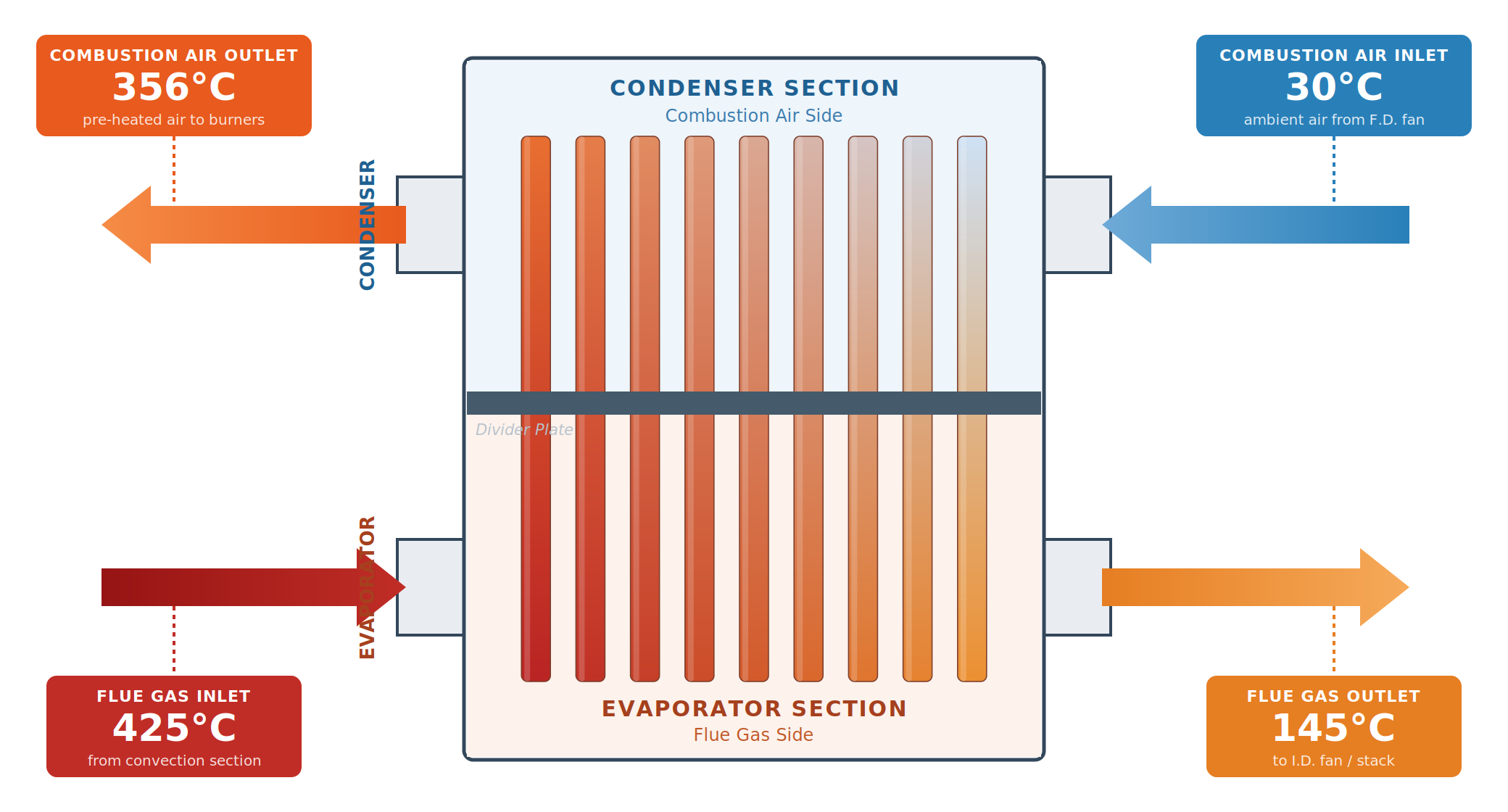
In an HPHE, heat pipes sit in a grid and boxed so the bottom chamber forms the evaporator and the top forms the condenser. The hot fluid flows through the shell side of the bottom chamber; the cold fluid through the top — in counter or cross flow.
Because the two chambers are physically isolated, there is no path for cross-contamination between the hot and cold streams.
Why it outperforms conventional exchangers
1 · Higher effectiveness
Phase-change transfer gives a higher effectiveness (ε) than shell & tube or fin-tube exchangers, translating to 15–25% less heat-transfer area and a smaller footprint for the same duty.
2 · No cold-end corrosion
The source never sees a cold end and each isothermal row runs at a uniform temperature — eliminating cold spots and pitting. Flue gas can be cooled 20–80°C further than conventional units allow, close to or well into the acid gas condensation zone.
3 · 100% process isolation
Isolated chambers prevent cross-contamination. For safety-critical duties, a twin tube-sheet design with a 10–15 mm air gap guarantees any leak vents to atmosphere, never to the other stream. This is especially critical for anhydrous or water-sensitive reactions and for heat recovery from purified product streams.
4 · Long life & low maintenance
Pipes expand freely to avoid thermal-stress buckling and use minimum Schedule 10 wall for extra corrosion allowance. Cleaning and servicing happen in-situ, with in-house teams and short turnaround.
5 · Handles challenging fluids
Sooty, corrosive or dirty streams are all within reach. Comfit Enersav, in collaboration with CSIR – National Metallurgical Laboratory, has developed a special thermal spray coating for handling highly corrosive fluids reliably.
6 · Multiple redundancy
Unlike a conventional heat exchanger, each heat pipe operates individually. Failure of a few heat pipes does not impact HPHE performance the way a failed tube would in a shell & tube unit — operations keep running, thanks to process isolation.
Heat Pipe Air Pre-Heaters
Typically in refineries, a conventional APH must keep flue-gas vent temperature above ~160–170°C to avoid corrosion. A Heat Pipe APH of the same footprint cools it to ~145°C without cold-end or pitting corrosion.
Every 20°C recovered from flue gas lifts fired-heater efficiency by ~1% — while removing the 3–4 year replacement cycle of glass-tube/cast APHs.
Want to evaluate the potential for heat recovery at your plant?
Book a heat-recovery assessmentBreak new ground on the streams others give up on
The path to profitability and lower emissions runs through the heat already inside your system — including the difficult sources conventional exchangers can't recover.
Where HPHE fits
- Flue gases with high particulate / soot content
- Flue gases carrying SOx and other acid gases
- Purified product streams (e.g. from distillation)
- Corrosive & dirty fluids, effluent
- Reflux condensers for anhydrous / corrosive reactions
Flue-gas heat recovery
Coal/briquette-fired boilers carry 50–100 ppm SOx and 12–15% moisture, giving an acid-gas dew point of 114–124°C. Fuel-oil heaters sit around 135°C. That is why conventional units vent at 140–180°C.
An HPHE cools the same flue gas to 80–90°C, handling condensing acid gases without corrosion. The recovered heat pre-heats combustion air, feedwater or any process fluid.
Every 20°C recovered from flue gas improves fired-heater efficiency by about 1%.
Connect with us for exact savings and CAPEX for your unit.
Projects delivered & in negotiation
Aether Industries
Surat
An anhydrous Grignard reaction would normally need a neutral cooling-medium secondary circuit backed by a separate water-cooled circuit. Our Heat Pipe Condenser lets the plant cool directly with cooling water — eliminating the risk of water ingress and the associated process-safety hazard. Result: a successful installation and a repeat order.
Installed · reorderedUPL — PCl₃→PSCl₃
Jhagadia
The reactor's condenser was a trombone cooler that caused water spills and tube failures from non-uniform cooling. Our Heat Pipe Condenser lets the plant use cooling water while eliminating those trombone-cooler issues and removing the safety hazard through complete process isolation.
UPL — Flue-gas boiler
Jhagadia
Under commercial finalisation: cooling coal-fired boiler flue gas from 160°C to 85°C while handling the corrosion potential of condensing sulphuric acid. The recovered heat preheats boiler feed water, enabling steam savings in the deaerator.
Tata Steel
Meramandali & Athagarh
Sinter-cooler heat recovery at Meramandali is in commercial negotiation. A signed MOU with Tata Steel FAMD targets heat recovery from Submerged Arc Furnaces at their ferro-alloy plants — a first-of-its-kind in India's ferro-chrome industry.
JSW
Vijayanagar
Sinter-cooler heat recovery under commercial discussion — the largest single-project annual fuel saving currently identified across our pipeline.
Savings and CAPEX figures are estimated values based on project studies. Actual figures depend on plant conditions — connect with us for a unit-specific analysis.
Tell us your streams — we'll find the recoverable energy.
Book a heat-recovery assessmentEnergy experts who deliver optimal heat-recovery solutions
Comfit Enersav was founded to make a positive impact on a changing energy landscape. We help you recover heat from challenging waste sources — cutting carbon and hitting environmental targets while lowering utility costs and operating expenditure.
Understanding a customer's energy challenge and delivering the optimal recovery solution is our forte. We're a team with deep experience across the energy domain, passionate about innovation and applied engineering.



Let's talk about your heat-recovery goals.
Get in touchLet's find the heat worth recovering
Connect with us to learn how much waste heat can be recovered from your unit. We'll come back with an estimate and next steps.
Manufacturing Plant
Comfit Enersav Pvt. Ltd.
Survey No. 23/1, Part – II
Village Laxmipura, Ahmedabad–Mehsana Highway
Post Nandasan – 382705
Ahmedabad, Gujarat, India
Corporate Office
Comfit Enersav Pvt. Ltd.
601-602, The Ridge Business Hub
Opposite Novotel Hotel
Near Iscon Cross Road
Sarkhej – Gandhinagar Highway
Ahmedabad, Gujarat 380059